Guide
My dog eats too fast: how to slow it down
Dogs that gulp their food usually do it out of habit or competition, not hunger. The easiest way to slow them down is to make the food harder to get at: a slow feeder bowl, several small meals or food your dog has to search for.

Some dogs eat as if someone were about to take the food away. The bowl is empty before you've put the bag back, and afterward comes a burp, or at worst the whole meal back up on the floor.
It's common, and in most cases you can do something about it with fairly simple means. Here's why dogs gulp their food, how to tell if your dog eats too fast, and what actually helps.
Why do dogs eat so fast?
Usually it's not about hunger but about habit and instinct. Dogs are pack animals, and in a pack, whoever eats fastest gets the most. That behavior sticks around even in a dog that has never had to share a bowl.
A few things tend to make it worse:
- Other pets in the home. A dog that eats next to another dog, or a cat that likes a taste, feels competition even if nobody actually takes anything.
- How they grew up. Puppies that had to jostle for food in the litter often keep the pace as adults.
- Dry food in a flat bowl. Everything is out in the open and can be eaten in a few mouthfuls.
- Long gaps between meals. A dog that only eats once a day is often hungrier when the bowl comes.
How to tell your dog eats too fast
There's no exact limit, but if a portion of dry food is gone in under a minute, it's worth a closer look. Other signs are swallowing without chewing, coughing or choking during the meal, burping a lot afterward, or throwing up undigested food shortly after eating.
Why it's worth doing something about
A dog that gulps its food swallows a lot of air along with it. That causes discomfort, burping and vomiting. In large, deep-chested dogs, fast eating is also often mentioned as one of several risk factors for bloat (GDV), an emergency that needs a vet right away. If you have one of those breeds, that's an extra good reason to slow mealtime down.
On top of that, food becomes more of an experience when it takes a little time. The nose and brain get to work, and many dogs are calmer after a meal that took ten minutes than after one that took twenty seconds.
Five ways to make your dog eat slower
1. A slow feeder bowl
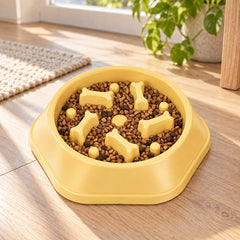
The simplest step. A slow feeder bowl has raised ridges in the bottom that split the food into small pockets, so your dog has to work around them instead of taking it all at once. You don't have to change anything else in the routine, just swap the bowl.

Look at two things when you choose: that the bowl stays put, and that it's low enough for your dog. A bowl that slides around the floor quickly becomes a toy instead of a bowl. The Nordicfall Slow Bowl has bone-shaped ridges in the bottom and six rubber feet underneath that keep it in place, even when your dog pushes with its nose. It's about 9 x 8.3 inches (23 x 21 cm) and low, so both small and large dogs can reach down.
2. Split the daily ration
Two or three smaller meals instead of one big one make your dog less hungry when the bowl comes. It doesn't change how much your dog eats in total, just how eager it is.
3. Let your dog search for its food
Scatter some of the food on a clean surface, in the grass or on a snuffle mat. Your dog gets to use its nose, and every piece takes time. It works well alongside the bowl, for example for the evening meal.
4. A puzzle toy for part of the food
A toy that dispenses food piece by piece turns a meal into a small task. With the Nordicfall Duck, your dog steps on a pedal and one piece of kibble drops out at a time, so your dog sets the pace. Take the food from the daily ration, not on top of it.
5. Give your dog peace at mealtime
If you have several pets, let them eat in different spots or different rooms. That removes the competition, and competition is often what drives the pace.
When to call your vet
The pace itself is rarely dangerous, but some signs shouldn't wait. Contact your vet if your dog vomits often, loses weight despite eating, seems hungry all the time or has suddenly started eating much faster than before. If your dog gets a swollen, hard belly, tries to vomit without anything coming up or becomes restless after eating, go to the vet or an emergency clinic right away.
In short
Most dogs that gulp their food do it out of habit. Make the food harder to get at, split the meals and remove the competition, and the pace usually drops by itself. Start with the bowl: it's the smallest change and the one you'll notice right away.